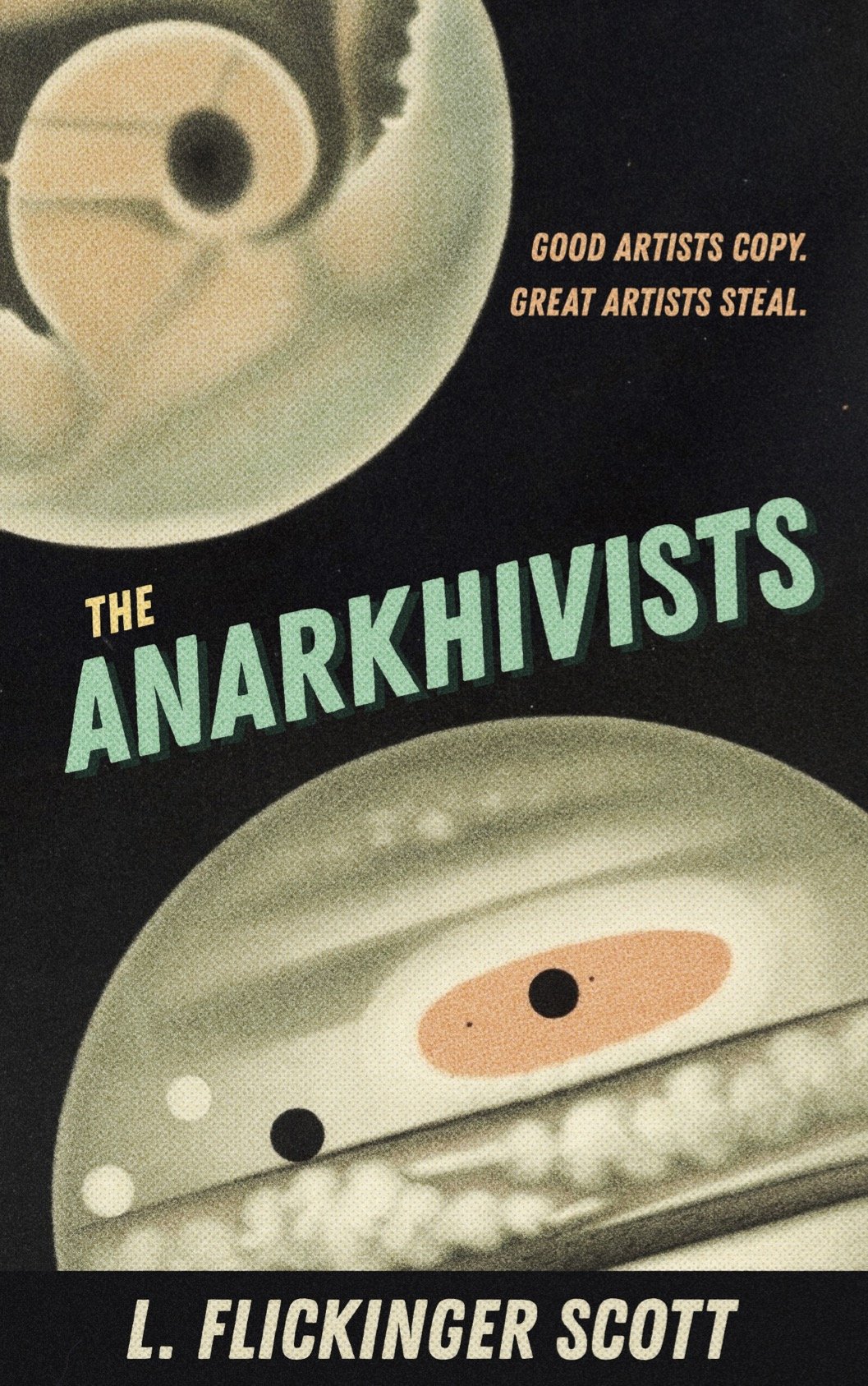
The Anarkhivists
A museum heist In Space.
A romance. A divorce.
An archive of Lost art.
and a spaceship that bites.
Good artists copy, but great artists steal, which makes Captain Rosalyn “Niz” Nizette-Rosario the greatest artist in the Solar System. Con artist, that is. But her newest crew member, no-nonsense rocket engineer Alta Aminoa, is determined to keep her hands clean of any dirty business. Despite her best intentions, Alta falls into the cosmic, bohemian world of these prolific art thieves. They work for the Anarkhive, a league of rogue librarians that rescue banned masterpieces and find lost treasures in a shrinking, corporate outer space.
Niz, Alta, and the rest of the crew must prepare for their most dangerous heist to date—to rob an ancient painting from within the most illustrious art museum on Mars, the algorithmically curated Musée Nouveau du Phobos. However, plans derail when Niz’s marriage disintegrates, and Alta finds herself falling in love with one of their marks: the museum director’s assistant. A successful heist could bring with it a reminder of the Earth that’s been lost in the swarm to the stars, but getting caught would result in broken hearts, life in prison, and the irrevocable burning of a rare romantic masterpiece.
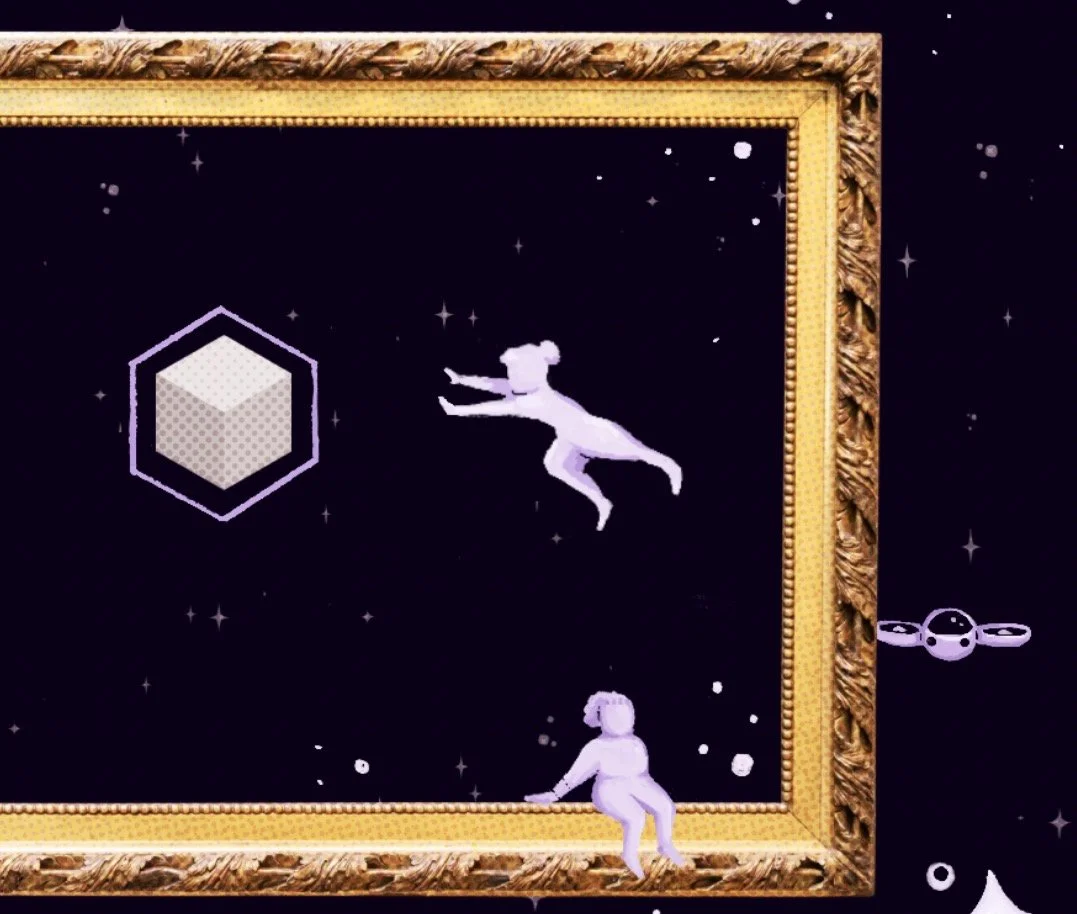
Excerpt From Chapter 12:
The Kaleidoscope [Generation 07.02.003]
“Cut the hippie shit,” I repeated, losing what little patience I had left. “Just say it plain, Niz.”
“What do you think I’m doing, Alta? You asked for an explanation, I’m giving it. Now it’s your turn to listen. I know you’re smarter than this. Do you legitimately believe that humans never made anything on Earth, then one day miraculously figured out how to build rocketships?”
I faltered. She caught the crack in my facade. “That’s science,” I said, attempting to recover. We had tools for ages, but art’s the bullshit frosting on the cake. It ain’t the meal.”
“Is that so?” She laughed, too jovial for the tension. “Is there no precision in baking? No chemistry in ceramics, no art in arithmetic, no craft in craftsmanship? Did you not feel the life with Magnolia this afternoon? Because I felt her takeoff, you’ve inspired the machine. But do not pretend that you know my art better than I.”
“So what’s your art?” I asked.
“I’m a thief. I do not pretend to be anything else. I delight in the art of a beautifully executed heist.”
“Some ‘from the rich to the poor’ crap, if it’s not for the money?”
“Not exactly,” Niz said. “That’s Pysces’s oeuvre. I would consider myself a savant of a good forced repatriation. I’m a treasure hunter, Alta. Flood stories are universal, and yet, most don’t know of the flood that culled nearly all art from existence when we Swarmed. Only one millionth of one percent of all that has ever been created still exists. I keep that number from shrinking.”
I didn’t say a damn word. She kept talking.
Humans have always been remarkably human. Technology shifted and rockets flew, but people had a delightful knack for being. Those on the Dead World could once see the stars, until the day the sky began to fade. Each advancement stole constellations from their heavens. Storms grew worse. Atoms split. We landed on Luna, then Mars, then Europa. We built swill machines left them running to devour the landscape indefinitely. The story always went that people Swarmed like the bee. When a queen outlived her usefulness, she was disposed of and the workers flew off in search of a new home. I’d always been told that the Dead World died, and so we Swarmed. But Niz said that depiction of cause and effect was not, in fact, true. We wrecked the planet in order to Swarm. We swore we could thrive without her.
Stories were easier to sculpt when one sole Corpe controlled production. The choke point of our re-settlement created a sculpted narrative free of guilt over the world we’d abandoned. Power coalesced; the flood hit. The Swarm opened an opportunity to enact the largest creative culling ever seen. All art from Earth was declared to be barbaric, degenerative, retrograde, and uncultured in the shining light of the new System. Images of home were automatically erased. Thousands of years of culture and knowledge disappeared in a blink. Digital records were wiped at the discretion of apathetic algorithms. There were not enough words left to describe how much humanity lost. Our collective library fell long before the masses noticed the ripple.
Under the Corpe’s, long list of rules were drafted, detailing which content could or could not be discussed, regardless of medium. Only the most palatable works from Mercury to MakeMake could be created, and only as long as they were assured to generate maximized profit. If a toddler couldn’t consume it, no one could. Art for everyone or no one, no exceptions.
Every book we’d picked up on Ceres had been banned for one reason or another. The Magnolia crew saved them to be archived regardless of legality.
Because humans have always been so very human, Niz said, and there was nothing more human than the art of making, regardless of context or circumstance. Even from the darkest shadows, stories were told, through paint, through song, through the hidden language of film. Art was not a byproduct of comfortability—it was what remained when backs were against walls. In the face of a flood, those on the fringes got a little, well, creative.
Librarians, archivists, artists, and bystanders saw the cull coming. They followed human instinct to grab what they dared to save and climb to higher ground. Intentional repetition dragged the intangible through time, allowing what little of the past they could foster to live on in a dream of the future. Creation unified. Seeds proliferated. Technology and material worked hand in hand, communicating the heart’s pain without a single word spoken. Unbridled creation became the art of rebellion.
“My team and I are members of the Anarkhive, a collection of thieves that seek what has been lost. Art is entropic, which makes it dangerous. And yet, it is inevitable,” Niz said. “The Corpe hates what it cannot shape. It abstracts treasure to assets in the hope that the masses will not covet the hoard. But art moments—those complicated, devastating thrills where souls fire like synapses—open the door for change. That continuation of human tradition makes life worth living. I fight to protect it. That’s the truth. I’m an art thief in search of what fragments survived the continuous cull. I know what I treasure. Do you?”